Thank you for taking the Ashton Court Trek. We hope you enjoyed it.
What next?
See what other Bristol Treks you could take – Bristol Treks
Ashton Court Rownham Woods Clifton Suspension Bridge
Thank you for taking the Ashton Court Trek. We hope you enjoyed it.
What next?
See what other Bristol Treks you could take – Bristol Treks
The UWE Bower Ashton Campus (home to the university’s Department of Art and Design) and the neighbouring Kennel Lodge Road Allotments share a unique, interconnected history. Both sit on land that once belonged directly to the Smyth family’s massive estate
From here head east to the end of Kennel Lodge Road. Turn left onto A369 Clanage Road and cross at the crossing. Continue north toward Clifton. On your right handsome is Bedminster Cricket Club.
Kennel Lodge Road – named after the hunting dog kennels that used to be there.
The University was built on The Paddock – a Grade II registered historic landscape, the university had to blend into the ancient tree canopy.
The Meadows – the smallest allotment (over the wall on the left) and used to where carriage horses and a dairy herd were kept
1930s – The allotments were established as independent of the council and managed by the Hotwells & District Allotments Association
1969 – UWE campus opened as the West of England College of Art. It was built to re-house the historic art school originally run by the Royal West of England Academy (RWA) in Clifton.
Animals – spotted at the allotments include weasels, foxes, toads, voles and newts (there are 15 freshwater ponds)
Not just allotments – there is a community orchard, wild wood forest garden, and a communal compost toilet
Artist and sculptor – Sir Richard Long studied art here at before becoming a pioneer of Land Art and winning the prestigious Turner Prize in 1989
This is the site of the Ashton Court Red Deer Park, one of the oldest enclosed deer parks in England.
From here follow the white marker posts straight ahead back down the hill to the Ashton Court Courtyard Cafe Car Park.
The 50-Metre Rule – Always stay at least 50 metres (about 5 bus lengths) away from the deer. If they stop eating and look at you, you are too close!
Dogs on Short Leads – Dogs must be on a short lead at all times while inside the deer park.
Stick to the Posts – The white posts show the paths. Avoid wandering blindly into the deepest ferns, as deer often hide their tiny, newborn calves in the undergrowth during the summer months.
1393 – Thomas De Lyons obtained a licence for an enclosed deer park from Richard II. Because it has been walled off and protected from development for over 700 years – it has excellently preserved archaeology
1545 – Wealthy merchant John Smyth bought Ashton Court and massively expanded it to include almost the entirety of the village of Long Ashton, along with vast swathes of agricultural land reaching all the way into Bedminster, Whitchurch, and Abbots Leigh.
Big! – The Red Deer park today is around 200 acres and home to about 90 deer.
Antler Facts –
1 – Only the boys (Stags) get antlers
2 – They grow a new set every year
3 – They grow 2cm every day! The fastest-growing tissue of any animal on Earth. [1, 2, 3, 4, 5]
4 – While they grow they are covered in a soft, furry “velvet.”
High Jump – Red Deer can leap two metre high fences—that is taller than a fully grown adult human!
Speedy – Red Deer can run up to 50 kmh or 30 mph.
Splash! – Red Deer can swim.
The Loudest Shout Wins the Girls – In the autumn, to avoid dangerous fights, stags stand a few metres apart and have a giant shouting match! They roar as loud as they can. The loudest wins and gets to go out with all the ladies in the herd.
Scary Fancy Dress – To make themselves look bigger and scarier, stags might roll around in muddy puddles and attach clumps of grass and twigs to their antlers [1]
Camouflaged Fawns – Baby deer (fawns) are born with bright white spots on their coats. When they lie down in the long grass, the spots look exactly like patches of sunlight filtering through the trees, making them completely invisible to predators. [1, 2]
They’re listening – A red deer can rotate its ears in different directions at the same time, just like radar dishes, to listen for danger from two different places at once! [1, 2]
They’re watching — The stags like to hang out on the high ground – where they can keep an eye on things.
Secret Shelter – After you pass over the crest of the hill you dip through a hollow where the view of city completely disappears. This dip forms a natural amphitheatre that traps heat and blocks the wind, which is why you sometimes find the fawns and does nursing here.
Pollarding – The hollow features some of the estate’s oldest “pollarded” oaks. Medieval farmers hundreds of years ago used to chop off branches to harvest wood. The trees grew new branches but ended up with massive, twisted trunks that look like something out of a fantasy film.
Fattest Tree – Amongst the woodland on the right after the hollow is a 900 year old Oak known as “the fattest tree’ (it has a circumference of 30 feet or 9m).
This is the site of Ashton Court’s Clifton Lodge. The northernmost historic entrance to the parkland.
From here turn immediately left and follow the path to the red deer park entrance.
Built for posh guests using the Suspension Bridge – It was built to give access to aristocratic guests from Clifton using the brand new Suspension Bridge
Style – It is built of limestone in the Victorian Gothic style
Ride in Style – It leads to a mile long lime tree lined carriage path to Ashton Court mansion
Access – It now provides access to the fallow deer park, red deer park, golf/foot-golf/disc-golf courses, two cafes, mountain bike trails, miniature railway and Tree Tops High Rope adventure park.
This is the site of an ornate Water Fountain (that no longer works), and an Ice Cream van that serves enormous whip ice creams.
From here head back over the Suspension Bridge and stay on Bridge Road to the end, where you will be facing Ashton Court’s Clifton Lodge. There’s a traffic light controlled crossing to the left
Fountain – Can you spot the following features:
CAPITAL – The top of a column
CARTOUCHE – graphic ornaments
CONSOLE – decorative bracket
FILIGREE – fine ornamental work
FINIAL – ornament at the top of an arch
FRET – a repeated ornament
GRIFFIN – winged lion (guards treasure)
LUNETTE – half-moon shaped space
PATTÉE CROSS – where the arms of the cross widen as they go out (e.g. Maltese or Iron Cross)
PEDESTAL – support for a column or statue
PILASTER – ornamental, non-supporting column
PLINTH – flat base
TERMINAL – statue or ornament on a pedestal
CAPITAL The top of a column
CARTOUCHE graphic ornaments
CONSOLE decorative bracket
FILIGREE fine ornamental work
FINIAL ornament at the top of an arch
FRET a repeated ornament
GRIFFIN winged lion (guards treasure)
LUNETTE half-moon shaped space
PATTÉE CROSS where the arms of the cross widen as they go out (e.g. Maltese or Iron Cross)
PEDESTAL support for a column or statue
PILASTER ornamental, non-supporting column
PLINTH flat base
TERMINAL statue or ornament on a pedestal
| CAPITAL | The top of a column |
| CARTOUCHE | graphic ornaments |
| CONSOLE | decorative bracket |
| FILIGREE | fine ornamental work |
| FINIAL | ornament at the top of an arch |
| FRET | a repeated ornament |
| GRIFFIN | winged lion (guards treasure) |
| LUNETTE | half-moon shaped space |
| PATTÉE CROSS | where the arms of the cross widen as they go out (e.g. Maltese or Iron Cross) |
| PEDESTAL | support for a column or statue |
| PILASTER | ornamental, non-supporting column |
| PLINTH | flat base |
| TERMINAL | statue or ornament on a pedestal |
Folklore – Ex-Prime Minister Margaret Thatcher invented Mr. Whippy ice cream
History – Margaret Thatcher worked as a chemist at J. Lyons & Co. and researched emulsifiers used to inject air into ice cream to make them lighter and cheaper to produce. This had already been done in the USA. The Mr. Whippy brand was developed independently by a different company.
This is the site of the Clifton Suspension Bridge Playground (also called the Sion Hill / Clifton Down Play Area) located right on the edge of the Clifton Downs on the Gloucestershire side. It is tucked behind the trees just a short walk north from the Clifton Observatory.
From here head to the Ice cream van located next to Clifton Down Fountain.
The play equipment includes a large timber climbing fortress, a tube slide, traditional swings, a toddler climbing frame, a basket swing, spring rockers, and stepping logs and balance beams.
2014 The park was remodelled
Hill Fort – The earthworks around the park were part of defensive structures around Clifton Camp an Iron Age Hill Fort that used to be located where the Observatory is.
The hedgerows were planted to help local birds and wildlife and protect the park from the gusting winds that come up from the gorge.
This is the site of the Clifton Observatory and Cafe. This is the entrance to the Giants Cave and the Camera Obscura and commands amazing views of the famous bridge.
From here head back towards the Rock Slide but take the path to the left towards the play park.
305 AD – when Britain was part of the Roman Empire – the giant’s cave was a secret christian chapel – but the only access was to climb Ghyston cliff
1480 – a chapel was reported to be in the cave in Ghyston Cliff
1766 – The Observatory was built as a Corn Mill and had windmill sails.
1777 – The Observatory (now a snuff mill) burned down.
1800s – The cave was a robbers lair
1829 – William West created the camera obscurer – making it the oldest working one in the UK
1835 – William West dug the tunnel from the Observatory to the giant’s cave after discovering natural crevices when digging foundations for what is now the cafe.
Folklore – The giants cave is an ancient feature and said to have been the home of the giant Vincent aka Goristone aka Ghyston. Vincent the Giant competed with the Goram the Giant for the love of the Water Nymph Avona. Vincent won by digging out the Avon Gorge.
Hill Fort – The Observatory is on the site of an ancient Iron Age Hill fort.
Windmill – The Observatory building used to be a Windmill for milling corn and later snuff (a tobacco that people used to sniff up their noses!)
This is the site of the Clifton Rock Slide. It has been a rite of passage for Bristolians for over 200 years. Have a catcher at the bottom and see who’s the fastest.
From here follow the path round to the left and onto the Clifton Observatory and Cafe.
1793 – a section of the limestone cliff collapsed revealing the slope that locals started to slide down
Mirror Finish – thanks to being polished by thousands of bottoms!
Ancient – The oldest documented, continuously used urban natural slide in existence – in the world!
Folklore: The following famous people may (or may not) have slid down it….
Famous Bristolians – Banksy, members of Massive Attack, members of Portishead, Alice Roberts, Tony “Baldrick” Robinson and 1950s movie star Cary Grant (real name Archie Leach) who always took his Mum to tea just over the road at the Avon Gorge Hotel when he came back to visit from Hollywood.
Famous students –
Clifton College – John Cleese, Michael Redgrave and Trevor Howard
Bristol Grammar – Timothy West and Mark Watson
Bristol Uni – Julia Donaldson, Emily Watson, Jason Isaacs, Derren Brown, Matt Lucas, David Walliams and Simon Pegg
UWE- Russel Howard, Bear Grylls, Adjoa Andoh and Miranda Hart
State schools – Stephen Merchant, Maya Jama and Josie Gibson
Nobel Prize winning bottoms of Bristol – Paul Dirac, Sir Peter Higgs, Sir Cecil Frank Powell, Sir William Ramsay, Sir John Kendrew, Sir John Hicks, Sir Nevill Francis Mott, and Sir John Pople.
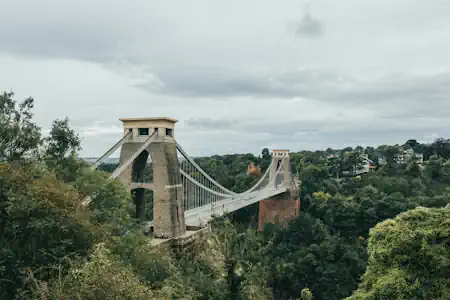
This is the site of Isambard Kingdom Brunel’s famous suspension bridge.
From here head over the bridge turn left onto the steps that are immediately after the kiosk and before the cafe and toilets and head off toward the Observatory.
Not for cars – It was designed to carry people and horse and carriages – but was so over-specified it can still cope with 11,000 cars a day!
Brunel died before it was finished – The bridge took 33 years to complete, outliving Brunel himself
Heavy – The bridge weighs 1,500 tonnes. That’s the same as 500,000 bricks – which if laid end-to-end would stretch for nearly 70 miles (further away than Southampton)!
Boing! – In 1979 the bridge was the sight of the worlds first modern bungee jump.
Parachute Dress – In 1885 a woman survived a 250-foot fall off the bridge thanks to her victorian skirt acting like a parachute [1, 2, 3, 4]
Choked – Brunel swallowed a gold coin during a magic trick. He then had to invent a giant machine to save his own life after he swallowed a gold coin during a magic trick (it strapped him down and spun him rapidly until the coin was ejected from his throat)!
Brunel’s top hats – concealed a notebook, pencils, blueprints, engineering calculations, and cigars!
Smoking! – Brunel was an absolute chimney who smoked up to 40 cigars a day
Bonjour – Brunel’s first name is French (like his Dad)
Don’t Mention His Height! – Brunel hated being called short and wore boots with thick soles and sat on extra-high cushions to appear taller.
Monster Builder – Brunel built fast and heavy trains that terrified Victorians called “The Great Western Monsters.”
Near Death – Brunel nearly drowned while showing off at the Thames Tunnel
Prison – Before he was famous, Brunel had been in debtors’ prison with his Dad
Not always a success – Brunel’s SS Great Eastern was a ginormous luxury floating palace that nobody wanted to buy.
This is the site of the Clifton Suspension Bridge Museum.
From here head onto the Clifton Suspension Bridge.
Secret Underground Cathedral – For over 140 years, engineers believed the massive 110-foot stone abutment supporting the tower near the museum was completely solid – but in 2002, a contractor accidentally broke through a wall and discovered 12 massive, hidden vaulted chambers inside.
Hard Hat Tours – The museum is the start point for Hard Hat Tours that let you climb down to explore these echoing, stalactite-filled vaults. [1, 2, 3, 4, 5]
Danger! – The museum features archive photographs of early maintenance crews who had to paint the bridge without any safety harnesses, relying entirely on balance and nerves of steel.[1]
Egyptian Sphinxes – Were included at either end of the bridge in one of Brunel’s rejected designs [1]
Recycling – To save money, they recycled the iron suspension chains from the demolished Hungerford Suspension Bridge in London[1, 2]
Weighbridge – the iron plate in the road outside of the museum is a weighbridge and alarms go off to stop heavy lorries from going over (there’s a working weighbridge that you can interact with in the museum).
3-Dimensions – The museum has a collection of 3D photo’s and a stereoscopic viewer to view them with.
Burgh Walls Camp (historically spelled Burwalls, Bower Walls, or Bowre Walls) was an important Iron Age hill fort that stood on the Somerset edge of the Avon Gorge, right at the top of Rownham Hill nearly 3,000 years ago.
From here turn right onto Burwalls Road. Follow the road to the end where it joins Bridge Road. Turn right and head towards the bridge. The museum in on the other side of the road.
One of Three – Burgh Walls Camp was part of a triple-fortress system guarding this narrow, tidal stretch of the River Avon. The trio consisted of: [1, 2]
1 – Burgh Walls Camp: On the southern flank of Nightingale Valley.
2 – Stokeleigh Camp: (Sill intact in Leigh Woods) on the northern flank of Nightingale Valley.
3 – Clifton Camp: Directly across the gorge where the Clifton Observatory stands today. [1, 2, 3, 4]
Big! – Burgh Walls fort covered 7 acres (4 football pitches) and used the cliff, banks and ditches for protection
1868 – When the Suspension Bridge was completed in 1868, the Victorians destroyed the fort to build houses
Burgh Walls House – (next to the Suspension Bridge) was built in 1872 right onto of the central enclosure of the old hill fort for the newspaper editor Joseph Leech.
Student Halls – Burgh Walls House was once a university halls of residence.