Description
This is the site of Rownham Woods. Keep left whilst following the steep path up the hill to Burgh Walls. Don’t worry – there’s a rest-bench on the way and some handy country steps to make the ascent easier.
Directions To Next TrekTik
Having kept to the all the lefthand turns up the hill through the woods, you will arrive at a seating area and information board surrounded by iron railings. This is the site of Burgh Walls Camp
Fun Facts
Huge Woodland – The woods used to extend to both sides of the river. The northeast bank was cleared of trees when Georgian Bristol expanded after the 1790s.
Really Huge Woodland – The woods used to include what is now Leigh Woods to the north.
Hidden Monarch – King Charles II hid near here following his defeat at the Battle of Worcester. He disguised himself as a servant to cross the River Avon at Rownham Ferry and hid in the thick woods on the Abbots Leigh estate nearby.
Flora (Plant Life) in woods
| BRISTOL WHITEBEAM | This tree grows naturally nowhere else on Earth. [1, 2, 3] |
| WILMOTT’S WHITEBEAM | unique to the Bristol side of the woods. |
| LEIGH WOODS WHITEBEAM | unique to the Bristol side of the woods. [1, 2] |
| OAKS & LIME TREES | were “coppice” and “pollard” managed. [1, 2] |
| WILDFLOWERS | include Bluebells, Wood Anemones, and Wild Garlic [1, 2, 3, 4] |
| SCURVY GRASS | sailors used to eat this because its Vitamin C prevented scurvy. [1] |
Fauna (Animal Life) in the woods
| PEREGRINE FALCONS | Famous for nesting on the sheer limestone cliffs above the towpath. |
| GREATER HORSESHOE BATS AND DAUBENTON’S BATS | live in ancient tree hollows |
| HAZEL DORMOUSE | A protected species that thrives in the dense bramble and hazel undergrowth of the lower woods. |
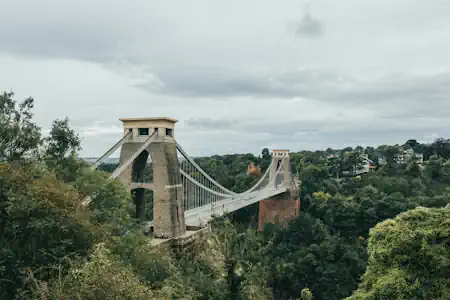
| RAVENS AND JACKDAWS | Noted as the most visible, vocal birds wheeling around the rock faces near the suspension bridge. [1, 2, 3, 4, 5] |